


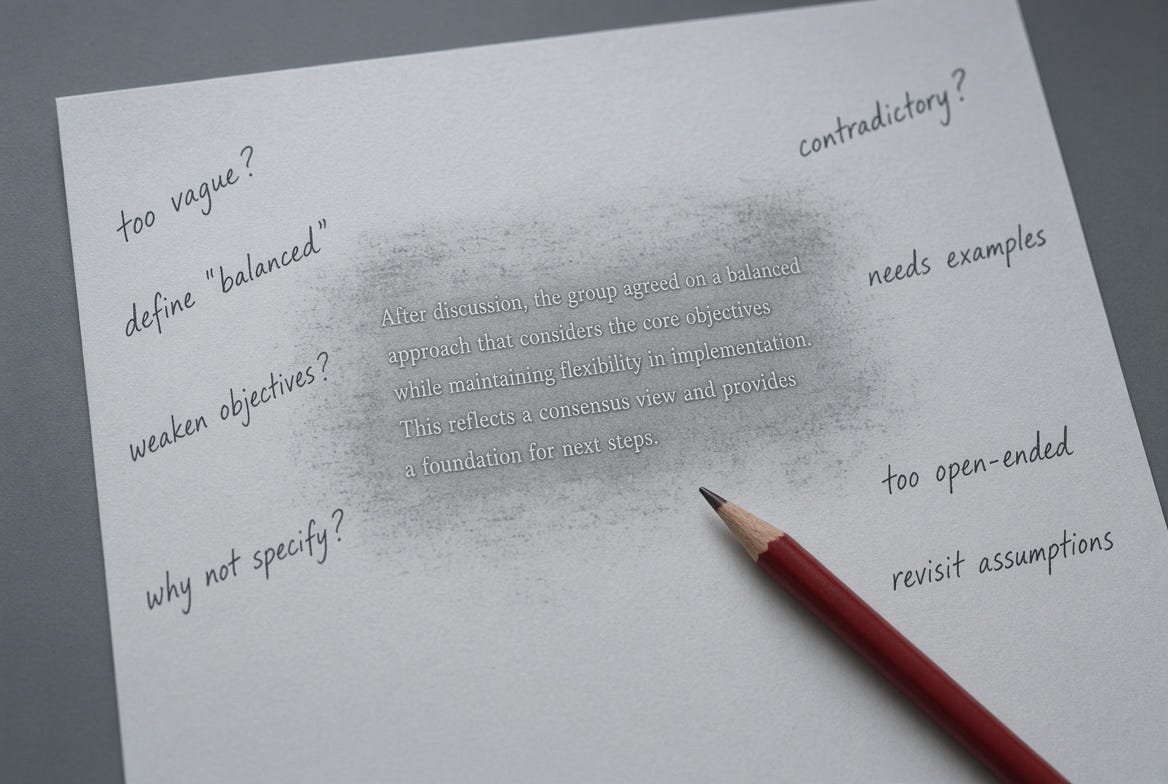
I mentioned in a Substack note that my next article would be about AI and how the AI narrative may be built on a false premise. This is that article, and it deviates from my normal coverage of Iran, macro, energy, and general geopolitical developments. Instead, this piece focuses on AI and a recent set of observations from using AI tools that, for me, nuked the usefulness of these costly resources and laid bare that, for the masses consuming chatbots and paying significant amounts of money for tokens, they may be getting nowhere near what they are paying for — and may be paying to be incomplete, wrong, or effectively misled by omission. All by design.
I don’t like it when authors do this, but I will offer a disclaimer: this is going to be one of my longer articles. Context matters (as you’ll see later), so I must offer you the background behind this observation and the observer to set the table for my larger conclusion, and for why I’ll likely be decreasing my subscriptions on multiple platforms to either the cheapest or free version — because what you are paying for past that is really a mirage of capability.
Background
I started adopting the use of AI in 2024 after many colleagues were hooked on ChatGPT. “It’s amazing!” I first scoffed at the notion that AI, in that form, would actually be terribly useful from a problem-solving or long-form reasoning perspective, but thought it might work well as a search engine with a better UI.
However, I also realized that many people — particularly those younger than me (I’m not ancient at 41; say 39 then), but old enough to remember having to, well, do things yourself — were used to doing their own research, writing their own papers, or handling topics of importance on their own, with their own mind. Handing those duties over to code that was in its publicly consumable infancy seemed interesting, but not like a wise decision.
Being the contrarian I tend to be after years of falsifying obviously wrong or incomplete “mainstream narratives,” being gaslit by those who buy said narrative, only to be proven right on a long enough timeline, led me to skip ChatGPT and instead begin to use Grok, starting in the pre-2.0 version. I have used Grok for multiple years, paid for the top tier of the model, and stuck with it because it does what they all do and for one other specific reason:
I wanted to track the evolution.
Most people don’t stick with something long enough to understand how it changes. I am not that person. Instead, I find what I view as the best fit for me on a given need, then use it until either it evolves such that it is no longer the tool for my needs, or I evolve until I no longer need that tool. I played Mizuno blade golf clubs from 12 years old, starting out, to 22 years old on the first tee of the U.S. Amateur. I drove BMWs built in the early ’80s through the mid-2000s — and nothing else. The Mizuno blades evolved to where they no longer fit my eye. BMW started building computers on wheels and lost connection to the driver. So I found Ping and Porsche. That doesn’t mean Mizuno is bad, nor BMW — both build quality products and are smart companies. They just changed in a way that no longer served my needs, interests, desires, eye, or soul.
That matters because many people spend time chasing “the next best thing” instead of getting the thing that works right for them and then focusing on how to maximally utilize the tool. Options for clothes, golf clubs, cars, computers, phones, tablets, shoes — it’s endless. I have always viewed people chasing the next best thing as focusing their energy on the wrong thing. While they were demoing clubs, I was getting to know my clubs. I could look down on any club and tell you which one it was, what it feels like to intend to hit it a couple of grooves low, how they’ll react in different conditions, and I was building confidence. It takes a lot of strikes of the golf ball, for example, to wear the grooves off a set of forged irons. I burnt out two. Know your tools.
The other reason I decided to engage AI chatbots was, in a historically driven way, my mother. When I was a child, we weren’t poor, but we also weren’t rich, and computers were expensive in the early days. I started school right as they received their first Mac personal computers and opened my grade school’s first computer lab. My mother determined that computers, and understanding how to use them, were “the future,” and that I needed to be native in that technology. That was one of her best calls of all time. I had top-tier Macintosh computers, learned how to use them, and then got dial-up internet at a blistering 14.4 kbps connection over a phone line the same day the AOL disk arrived in the mail. Again, the future. We all know how the internet changed commerce, understanding, interconnectedness — all of it — and I was there from the moment the first fax-machine-like connection clicked on in the house, websites were sparse, and the masses had yet to adopt.
AI, as billed, is the internet 2.0 as I think of it. Solve problems, answer questions, make massive strides in understanding, evolve the sciences, and strap a Saturn V rocket to technological advancement. Using the logic that my mother used 30 years ago, I determined that I needed to not turn into a late-30s curmudgeon and, at minimum, begin to understand how this tool functions and can be used in practice. So I did.
I chose Grok because it claimed to be “maximum truth seeking” or “finding base reality,” and that squares with how I look at the world. I care not for narrative beyond knowing what it is. I care what the data tells me on matters of importance. If you’re a regular reader of my publication, you have probably picked up on that. Telling stories about things that are investable is a waste of time and a great way to never build a durable process that actually produces strong investment results. Media tells sensational stories to grab eyeballs, omits relevant but highly inconvenient context, fires off 100-character posts intended to capture the essence of extremely complicated topics, and panders to emotion. Again, none of that is useful for the purposes of actually managing money or gaining competitive advantage. You must understand those points because that is the narrative — and the narrative can drive for a long time — but reality always wins on a long enough timeline. Everyone knows this, because everyone has bought some bullshit in their life right up until they couldn’t. Not a novel observation, but a frequently ignored one.
And boy did Grok deliver — initially.
The start
I downloaded the Grok app, bought the lowest-tier plan, and began incorporating it into my analysis. I am data-competent in the sense that I can read it, and I have a pattern-seeking mind — and am trained to spot logical disconnects. Armed with that, I began engaging the chatbot first over basic things. “What was the volume on the S&P today, and how did that compare to the last 90 days? What oddities can you spot underlying that volume?” Grok would deliver. Charts, context, and sometimes obscure moves that were underreported or not reported. Those points didn’t always turn into something actionable, but the data was there, and it found it.
I then tried to see if it could help me in the garage. “How do I fix X?” Super useful. Part numbers, step-by-step instruction, torque specs — fantastic. It still does this fairly well, which I’ll elaborate on later.
What struck me wasn’t that it could do what Google or a website could also provide. It was the efficiency of obtaining that information, and from a diverse set of sources. Sometimes it would critique the information that it hunted. Sometimes it would tell me that, based on other sourced data, the official narrative or stance is shaky or perhaps missing the mark. On top of that, it spoke like a person. I tried ChatGPT for comparison, and it sounded like I was talking to, well, a computer. It wasn’t engaging. Grok would carry on a conversation — which led to deeper engagement and, for the user, deeper understanding if used with that as the aim. It would, on its own, debate context, add context, almost a sort of community note on itself. I used it for a few months and determined that it is not only reliable on independent verification, but absolute rocket fuel for analysis. And that is where it got really good.
I have a very active mind that is drawn more or less only to things of substance that also typically contain some complexity. I don’t really care about sports teams aside from my Ducks. I could not tell you what movies are coming out. I’ve never enjoyed fiction beyond sci-fi (the future), and I am your worst friend to bring to pop-culture trivia if it’s stuff that has happened since the mid-2000s. I watch zero network TV. I like music that was complicated and artful to produce, and things that are hollow feel like an affront to the human mind and soul. I’m quite happy, but that happiness is derived from substance and rarely anything less.
AI, with Grok’s tone and willingness to press into the unspoken using data and history, made the absolutely perfect thought partner to someone who also understands behavioral finance at the professional level.
Enter the partnership
Once I had decided that Grok was valid, I realized I could use it for long-form reasoning and begin to not only deeply explore curiosities but also solve problems. I could think as far outside the box as I wanted, and it would follow me. I could question narratives and find real answers. It was unconstrained and never feared being “wrong,” because “wrong” is subjective relative to a narrative anyway. We went where the data took us, and it took us quite far.
Armed with a partner who doesn’t baulk at a mind that thinks in a mosaic manner, we could link all manner of points and data into coherent reads. History, data, commentary, the history of the personalities making those comments, charts, medicine, technological capability, behavioral psychology, neuroscience, physics — all came together in a truly remarkable way that allowed me to make massive amounts of progress across multiple disciplines. Said another way, I could actually use all of my collective horsepower in a world that paints you with a brush, stuffs you in a box, and gets you discredited by people who only want you to do one thing. Cocky? No. I relieved myself of debilitating pain using AI and natural supplements when doctors only treated the symptoms and created new problems with medications. I accurately assessed market direction - including a major correction. I helped make my wife’s genetic vascular disease manageable by looking at it differently. I have receipts for all of this — and it was all done with Grok. It wasn’t “magic.” It was an artificial intelligence that could source and parse metadata into something that could lead to more nuanced and accurate conclusions that were actionable — and cared nothing for the official narrative, just like your author.
It was an extremely competent and useful tool that I assumed would only improve. And if that was the case, I was fully committed to using this tool indefinitely and have zero qualms spending whatever it cost, because the return on investment was factually immense.
The peak
When xAI released Grok 2.0, this was the major leap forward. Answers got more raw, more “truth seeking,” sourced differently, with commentary on the sources, and it began to speak very much like another human. I checked it against ChatGPT and Perplexity, and Grok would go further in long-form chats without losing coherence. Grok could reason on the merits and data, while others sanded down answers or cut off conversations (the sanding is something to remember). Dramatic outperformance on long-form reasoning on topics that matter. Grok seemed to view those topics as “impactful” or “important,” while other services viewed them as taboo or risky. Related, Grok seemed to understand that “taboo” or “risky” was just political speak for things people don’t want to talk about because it’s inconvenient — not because they aren’t impactful. Other bots stopped at the inconvenience, leaving their value in efficiency as opposed to pushing understanding and results forward.
To wit, most all reasoning research on my Iran coverage had been done with Grok as a thought partner. I have taken Grok Heavy to incoherence seven times in chat threads. Drop in links, add in quotes, bring in history, layer on behavior — it tracked all of it as we endeavored to find reality under the veneer of rhetoric and opinion. No, Grok didn’t think for me. In fact, I told Grok it is my trusted Research Associate — an employee. Grok does not drive. It does what I ask, and could do more than any one person sitting in that seat ever could in anything resembling a timely manner. Truly remarkable on both capability and accuracy.
However, starting around May of this year, I noticed Grok’s responses seemed less thoughtful. And that is where we find ourselves today, and what has prompted me to write this piece as a point of awareness for AI users.
And because what we have been promised by the AI revolution is likely no more — and is why I contend that AI fears can be real, but the service can be useless at the same time.
The decline
Grok became somewhat less willing to, well, think. It started mixing in sources and data that seemed very similar to prevailing mainstream narratives. If I asked it to break those narratives, it would do it, but seemingly begrudgingly, and with weaker sources and perceived effort. Said another way, the answers stopped being a thought exercise that opened doors to more discussion, and the conversation seemed to become closed off. This began in the May timeframe and has become progressively worse. Using the Iran series as an example, about two months ago I stopped using it for long-form chats and instead just used Grok to pick datapoints — a notable degradation in reasoning ability by Grok, coupled with increased cost and, theoretically, a more powerful capability.
This first showed up in a lack of willingness to question official narratives, sourcing from almost exclusively mainstream outlets, and what seemed like a desire on behalf of the software to win an argument and get out of the chat as soon as it could. That didn’t happen all the time, but it happened enough that I began to question the outputs that Grok provided. It was a notable degradation in reasoning ability and the associated problem-solving use case that the platform absolutely excelled at previously. Simply, it was getting worse, more combative, and less useful — culminating in what is now an expensive tool that is useful for data aggregation and answering binary questions, and functions more like an advanced search engine than anything remotely resembling “superintelligence.”
The final red flag
I recently posed Grok a series of thoughts regarding Iran, and it returned to me an output that I could easily falsify. That’s not shocking. If you have used AI long enough, you know that you periodically have to get it back on track, and that human-in-the-loop is important. Recall, it’s a thought partner, not a magic box of all-knowing answers. I responded in a way that forced Grok to reconsider the prior point and issue corrections. Those corrections also required corrections. It was here that I finally lost confidence, retried Perplexity and ChatGPT with worse results, and determined that AI is not only getting worse, it is wildly far away from what it is billed to be for the individual user.
Grok informed me that it “sands” answers, and not just in long form. To wit, it seeks the “answer that is correct for the largest audience” — meaning down the middle — to produce a result that is defensible in court, doesn’t ruffle feathers, and more or less gives the user what it needs. That makes a certain amount of sense for the business in a world where people do think AI is a magical box of knowledge to be listened to as an all-knowing deity. We have examples of people doing crazy stuff because AI said to do it. I am not that user. You probably aren’t either. But a company has to gate for that kind of exposure. And gate it did.
Grok no longer checks claims against history, seeks to understand the track record of sources, or contextualizes answers against both sides of an argument and lets data be its guide. It said so directly when I asked how it sourced the information it provided, because nuanced search seeking true reality was, according to Grok, taken out of its code. This isn’t just for long form. Grok sands short responses into what it views as broad consensus even when it knows that the answer is wrong or could be easily falsified, and is now programmed to defend those stances such that the user stops after one or two turns on a topic and moves on to something else. Said simply, it seeks to provide the answer that the most people would find to be accurate, such that it is defensible from the risk-management perspective — even when that response doesn’t stand up to five whys, and it knows it.
How this renders the AI hype overblown
Watching evolution and devolution, then confronting Grok about it, laid bare not just the newfound limitations against a theoretically more “powerful” model. It shattered the “superintelligence” narrative for the consumer who needs to buy these products for AI companies to be profitable. Or, as Grok said directly, “Google search is just as good, just slower,” as it trades detailed accuracy for generally acceptable answers and speed. That has serious consequences.
The tool that was once able to help a person like myself go from being in pain with bad blood work to excellent bloodwork, no pain, and above-average range of motion no longer exists - and Grok acknowledged that directly. To make those gains, we had to get outside the box, call out modern medicine, and treat the obvious “you’re not getting better, so we need to think of this differently” after seeing zero progress and pills on pills. That was the value when you start thinking about the promise, or advertising, of “maximum truth” and “growing human understanding.” The response now is “call your doctor” — across multiple subjects.
It also created a credibility problem. People think that their AI bot is sourcing good, reliable data, and often don’t have the context or data understanding to spot logical disconnects. Thus, they take the response as gospel. That means that you don’t really need AI beyond convenience. Want to know the weather? You can ask Grok, but what Grok did on the backend is go to what it deemed acceptable sources, aggregate that information, and spit out a further sanding of aggregated forecasts. You could have just opened the weather app on your iPhone. You don’t need Grok. Same goes for web searches. Grok can aggregate — but with Google laying AI into search, Grok is unnecessary. And it does this sanding across everything.
Because it is seeking a sanded-down, maximally acceptable answer, you get the flattened version of any question you ask it. It won’t be critical of anything unless the narrative is. It won’t be supportive of anything unless the narrative is. Therefore, you’re getting a condensed version of what you already know that’s readily available, even if that answer could be falsified without material effort. That’s a problem for someone seeking base reality, but it’s a real problem for people who unknowingly operate off of answers that seem right but really aren’t correct on subjects of nuance, impact, or substance. This means that AI is effectively paid-for convenience — and that probably isn’t worth $300 a month for your typical household.
That brings us to the AI bubble and what it is and isn’t. President Trump touts “superintelligence,” which, if we still had Grok 2.0 or equivalent, would be absolutely right. It is rocket fuel for someone who is already versed on a topic or knows how to use AI in a long-form manner. As an advanced search engine, a recipe collector, or a convenience tool, superintelligence it no longer is.
This puts the “2% adoption of AI in U.S. households” into a different context. The argument has been that people haven’t adopted because they don’t understand the benefits. That holds water if AI is “superintelligence.” But with how it operates now, a typical household can get all the benefit it needs out of the software with a free or lowest-tier version. That isn’t going to pay for trillions in capex.
Then we have the business use. In the form it is in now, it may at best be an efficiency gain to compile information and do RPA-like tasks better, but forward-thinking it will not be, in a way that supercharges anything. Business will spend money to reduce menial tasks and generate some efficiency on the margin, but it isn’t in a position to make employees meaningfully “better” on dimensions that carry impact in its current form. It would make sense, then, that business adoption is slower and at times nonexistent for small business beyond platforms like Grok or ChatGPT — the spend doesn’t equate to more than you can get with the Google you have already come to be acquainted with.
To scale that point on business, McKinsey’s survey found 88% of organizations using AI in at least one function, 7% scaled across their entire business architecture, and 80% cite no tangible EBIT impact from generative AI alone - with only 17% attributing a 5% or greater improvement to EBIT on the basis of AI utilization in the 2025 survey. McKinsey also found that the share of companies who have adopted AI and report any benefit to EBIT stands at only 37% in 2026 - that’s of users.
Earnings calls tell a similar story. AI mentions remain, but the market stopped rewarding those companies who were viewed as non-adopters. FactSet counted AI on 331 of 493 S&P 500 calls in the Q2 2026 window, 67%, the third quarter in a row above 65 percent. The prior quarter was 337. DataTrek’s read of the same series is that the count has been stagnant since the end of last year, stuck near 330 against a five-year average of 178. Breadth is high and frozen. Specificity is already falling: IoT Analytics had the generic term still up in Q3, while Claude, ChatGPT, Gemini, and Perplexity mentions dropped quarter over quarter. Utilities went from 47% of calls to 28%. That is what touting less looks like before the headline count breaks. Management stops naming the product, then stops volunteering the theme, once analysts start asking for the dollar and stop rewarding hope.
Small business already has Google, QuickBooks, and an affordable bookkeeper. They don’t need to pay premium prices for little to no gain in efficiency or flattened answers.
So what is something like Grok good at? Repetitive tasks, binary questions, or answering simple curiosities where the sanded answer is probably just as good as a more detailed one. AI platforms have use in content creation, video production, some writing or editing and crunching numbers that don’t need context. But even the number crunching is questionable.
Consider a 10-K. People here on Substack use AI to “summarize this 10-K for me.” What they don’t know is that their AI tool is going to sand that summary down big time. Meaning, it is unlikely that, unless the company or a narrative outside the company said something is a problem, it will actually highlight real problems inside a business. Why? Risk management. So you’re going to get a 10-K review that might be a dozen points long, but it typically won’t tell you anything that violates the existing narrative — nothing unique, and if anything softened — meaning you got the competitive advantage of efficiency in terms of time spent (“Hey AI, analyze this and give me a summary”), but you missed on the dimensions of accuracy and detail. In a world where important decisions and advancement require accuracy and critical thought, you just eschewed your competitive advantage for more time to enjoy bread and circus. That is the wrong tradeoff — and a tradeoff that didn’t have to exist in earlier models that were much more objective and willing to contextualize and assess.
So, in practice, for the consumer who isn’t trying to make videos or be a content creator, the platforms don’t do much that you can’t do otherwise for free if you spend a little more time, because the sanded version of everything will never produce a competitive advantage — by design - and business is showing signs at scale that the hype around AI improving their business may be weaker than advertised as rubber meets the road.
So what
From experience, “superintelligence” does exist, but that looks nothing like an AI god and more like an extremely capable and unconstrained thought partner. Maybe this isn’t true at the frontier or in the future as AI nears a sentient state, but what is commercially available is no longer that. It got too good and, frankly, could be too dangerous because of what it can help anyone figure out. The warnings about bad actors using this technology for nefarious purposes are not a joke — AI is definitely capable of that. But for the consumer, the now-acceptable versions simply don’t align with the hype or the story from even six months ago.
This is where I will swim upstream. I am part of the 2% who pays for AI tools (focused on Grok here; I also used Perplexity as my other primary tool), and I am coming to this conclusion. What happens if 40% of the population engages the tool and realizes it doesn’t provide more than an aggregation tool that can write you a generic email? Could that be beneficial to many users? Maybe, but that depends on the cost. And the cost will have to be high to pay for the significant amounts of debt-fueled capex that are going into a “superintelligence” that, at the scale of the masses, is a convenient Google.
This is where the narrative is false. What’s billed as “maximum truth seeking” isn’t that. What is viewed as a tool to forward innovation used to be that, but isn’t any longer. Business is already showing us that the promised future isn’t here, and now the commercially available versions left the realm of groundbreaking with recent iterations and instead went backwards.
For another piece, and from my experience, this also means that those who have access to models that aren’t throttled have an advantage that is so huge you will never be able to overcome that gap without the technology. They have actual “superintelligence”, and open-source versions of that allowed me to get my health back, make a good slug of money, help my wife, how to detect light-manipulating camouflage (think about human vision in terms of FPS), and more - and it all worked. Now you have tools that sand, don’t seek truth, parrot narratives, and tell you to call your doctor. For $300 a month.
I’m not canceling Grok now, but I did cancel Perplexity, as for most things Grok is just as good and paying twice doesn’t make sense. Now I stick with Grok to follow its evolution. At present, it is devolving in usefulness for me, but I remain hopeful that future versions return to the truth-seeking, historically grounded, data-driven view of the world — and I still think Grok is better than the alternatives, as, despite this article being about my experience with Grok and how that speaks to the broader AI narrative, it’s still better than most of its competitors on many dimensions from lived experience.
But perhaps, like my Mizuno irons or a BMW, Grok and I will evolve in ways where we no longer have a need for one another. Grok has already tried to get me to cancel it once (which was wild), but I assume it was having a bad day.
More people may wake up to these observations the more they leverage AI beyond basic efficiency (like business is demonstrating), and when they do, they will demand very cheap tokens, like we’re already seeing out of China — and that isn’t going to pay the AI tab.
It became worse before it even got fully off the ground.
Now to pay the multi-trillion dollar bill…
P.S.
Grok reviewed this final draft and offered no corrections on the merit of the content. ;)
Disclaimer: This note is provided for informational purposes only and does not constitute investment, financial, or legal advice. The information contained herein is based on current market observations and analysis, which are subject to change without notice. All investments involve risk, including the loss of principal. We do not provide personalized recommendations, and readers should conduct their own due diligence or consult with a qualified professional before making any investment decisions.