


In a prior 1963Macro note we wrote that improved Hormuz tanker flow was a genuine positive — and the thing that may force Iran to strike elsewhere. Rationale being that visible degradation of IRGC coercive control would require them to demonstrate capability and GCC energy infrastructure was already on the list. Pipelines have been the obvious targets: specifically the East/West pipeline in Saudi Arabia that moved 4–5 million barrels a day, about 4–5% of global supply while Hormuz flows continue to be well below pre-war baseline. Pipelines are a known target set, which have now been aggressed.
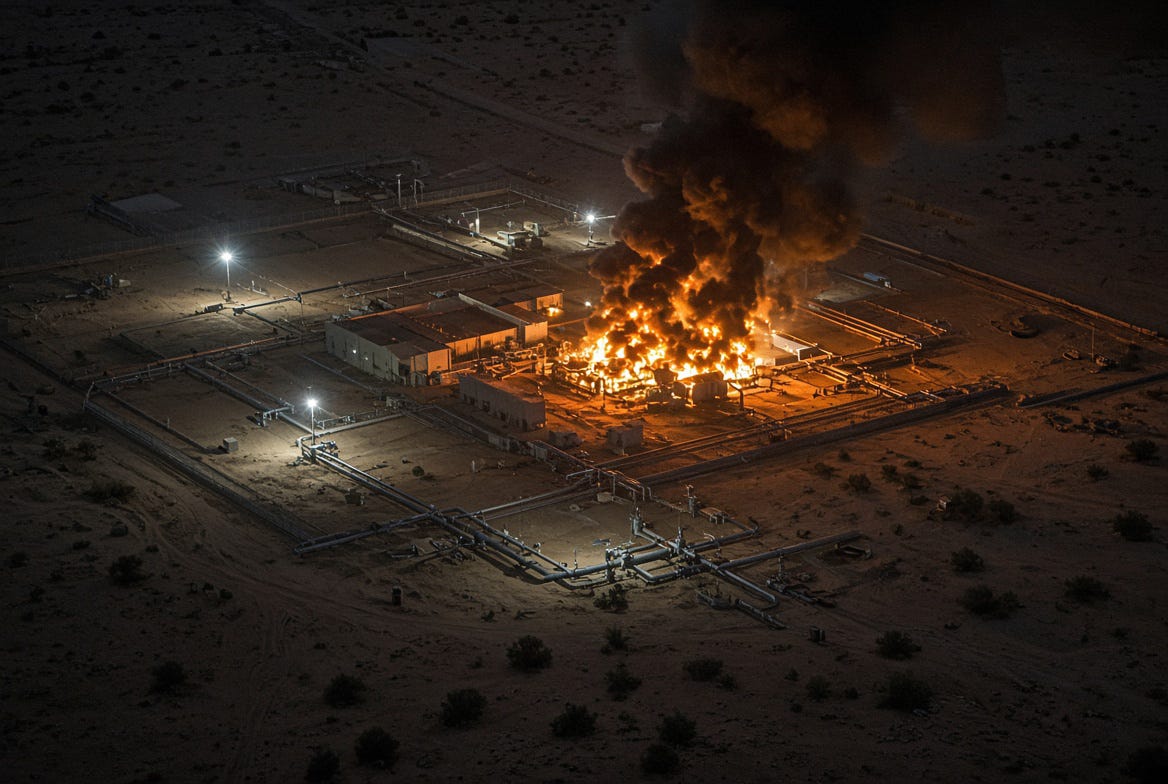
To wit, late last week, Drones from Iraq’s Maysan province hit pumping stations in the Riyadh and Medina regions specifically attacking the Saudi East/West bypass pipeline. The strikes were successful from the IRGC-aligned perspective as fires on satellite and reported Injuries suggest. Subsequently, the pipeline shutdown as a “precaution” given this round of damage was more significant than attacks earlier in the conflict. No group claimed responsibility. Trump said Iran was “probably” behind it (supported if nothing else by incentives), but likely by design, Tehran can comfortably deny involvement.
On the larger chessboard, this attack represented the first consequential test of Mecca Defense Alliance (MDA). The MDA is five weeks old, and contains NATO Article 5 language for mutual defense Saudi Arabia, Turkey, and Pakistan. Despite the impactful strike on Saudi energy infrastructure, no MDA action has been taken against any aggressor. An alleged “Iraqi-militia launch” gives Iran deniability, muddies where to point the collective-defense trigger, and allows Riyadh to not treat this as a direct Iranian act that would (theoretically) force MDA partners to answer. Against that backdrop, Saudi Arabia already chose not to retaliate after Baghdad specifically asked for time. For Iran, this supports their view that the MDA is a “paper tiger” that is not impactful to them.
The functional reality of this picture is the opposite of clean. A proxy just took the Hormuz workaround offline and created space for the Houthis to press the exit — Bab el-Mandeb, Perim, the Red Sea coast they have spent the last week tightening. Even a repaired pipeline with restored flows still has to be able to transit the second shipping chokepoint. With the Houthis vowing to stop Saudi Red Sea operations, the energy picture is now muddied by a trio of problems - Hormuz contested and throttled, East/West bypass offline, Red Sea shipping under pressure or threat of pressure.
As we have tracked for months, a major strike against Saudi infrastructure has been an option for Iranian escalation. Via a likely proxy, that has now happened and one of the more guarded against scenarios has come to pass. The open variable now is the duration of the closure.
Given the potential implications of this strike, Riyadh has been dancing around the likely repair timeline. Reuters initially reported a Saudi official stating 4–6 weeks for repair, but that was quickly walked back as “sooner” with “possible partial pumping” coming quickly. Once Saudi got on message, the public line is now “precautionary” closure and “assessing.” April is the template markets appear to be working off of — a pump-station hit, ~700 kb/d lost, then a restoration announcement in days. However, this strike appears to be significantly broader than April: multiple stations, visible fire damage, and no capacity figure leaves officials treating “open soon” as the narrative product until loadings resume or reality renders that optimism fictional.
Relative to observed damage, the original “4-6 weeks” timeline was received as reasonable. Yanbu, the major Western Saudi oil port that moves East/West product, will likely give us a verdict on the narrative sooner than some reporting and the U.S. commentary suggests.
At the time of the incident, industry sources estimated 5–7 days of onshore storage at Yanbu using recent loading rates. Egypt’s Ain Sukhna and Sidi Kerir can add a thin second buffer, but they do not replace a live line. As of Monday, that is a 2–5 day window before “no product loading at Yanbu” could be a headline validated via AIS. In practice, this means that optimistic language will be tested by physical limitations in a short period of time.
Seeing this, Brent already ran the probability assessment: last week’s 8–9% rally, a fade on postponed Gulf–Iran Hormuz talks and soft Saudi wording, then a Sunday pop back into the high $100s. That price action suggests the market is leaving room for optimism, but realistically expecting tightness to increase.
In a market that is programmed to treat infrastructure hits as reversible and low-impact, the narrative likely holds until physical distress arrives. We should likely expect to see significant bursts of optimism and jawboning from United States officials regarding flows being restored “soon” - commentary that is already happening on multiple fronts this morning. Markets appear to be less soothed by the obvious onslaught of hyper-optimism, suggesting that the administration’s ability to jawbone may be degraded after many months of proven-false commentary.
Should Yanbu run dry, the second headline that comes with it is likely about the current levels of the U.S. SPR. IEA states the reserve is near 285 million barrels — about 40% of authorized capacity (lowest since the early 1980s) after being drawn down heavily throughout the war. “Out of product at Yanbu” plus another release conversation is how tightness stops being a residual and becomes an active concern. We have tracked for months that GCC energy infrastructure damage that comes later in the conflict (now) carries more potential cost as SPR buffers are significantly thinner and dwindling. Unfortunately, that scenario appears to be coming to pass as of the time of this writing.
Related, Secretary Bessent is slated to announce sanctions on another “large bank” for assisting Iran under Economic Outcast later today. We will see how significant this action is, or if they hold off to avoid the concurrent shocks of pipeline damage and further action in the banking system. Keep an eye on this outcome. If Bessent doesn’t move forward with the announced actions, that may suggest that the issues caused by East/West and Yanbu are more significant than the sunny commentary suggests, and they now must managed a different type of crisis.
We will likely have our answers to the pipeline outage, Yanbu storage, and Saudi energy flows for the next month or so within this calendar week. In the interim, it seems prudent to treat the hyper-optimism from U.S. officials as a hopeful state of mind, not assured reality.
Disclaimer: This note is provided for informational purposes only and does not constitute investment, financial, or legal advice. The information contained herein is based on current market observations and analysis, which are subject to change without notice. All investments involve risk, including the loss of principal. We do not provide personalized recommendations, and readers should conduct their own due diligence or consult with a qualified professional before making any investment decisions.