

Next Stop – Sledgehammer: US–China Summit as Final Pause
Why Beijing’s pragmatism is a US advantage as the Iran clock turns kinetic

The US–China summit should be read not as a diplomatic off-ramp for the Iran conflict, but as the final procedural pause before the system reverts to kinetic default. China may protest and bargain on the margins, but Beijing’s pragmatism makes it more likely to absorb a US move against Iran than to meaningfully obstruct it.
Ahead of official meetings, Tehran’s position has hardened. Iran’s five-point response—end the war on all fronts, lift all sanctions, release frozen assets, pay reparations, and assert sovereignty over the Strait—was not a realistic opening bid. It was a public declaration that the regime will not voluntarily relinquish core leverage: proxy networks, sanctions narratives, and the ability to threaten shipping through the Strait.
Once Tehran sets maximalist demands, the burden of adjustment shifts outward. The question is no longer whether diplomacy can produce a US-compatible outcome; it is how the rest of the system—especially China—positions itself for diplomatic failure.
Beijing’s answer is likely realism. Chinese strategists view Tehran as useful but not worth a macroeconomic price to defend. China’s overriding interest is stability: steady energy imports, open shipping lanes, contained inflation, and a stable external environment for a fragile recovery.
A prolonged Gulf crisis that drives sustained oil volatility, higher freight and insurance costs, and trade uncertainty runs directly against those priorities. China can criticize US actions yet privately judge that contesting Washington over Iran would inflict outsized costs on its own agenda.
China also has options. Iranian barrels matter at the margin but are not irreplaceable: Russian flows, sanctioned-vessel workarounds, and strategic reserves provide partial buffers. The flexibility reduces the odds Beijing treats Iran as existential.
Accordingly, that asymmetry favors Washington. The United States has signaled two hard red lines—the nuclear program and weaponization of the Strait—while Iran has hardened public demands. Beijing can see which side is more willing to bear escalation costs, so it can bargain without needing to endorse US action.
That is why the summit matters: it creates an extraction window—a chance for Washington and Beijing to stabilize bilateral relations before escalation, not to resolve the conflict in Iran.
Washington enters with two levers. The first is pressure on Iranian energy exports, which is already constraining the crude and shipping network China has used to absorb sanctioned supply. The second is the credible threat of a short, high-impact military operation—a “Sledgehammer”: a limited, intensive clearance campaign designed to impose rapid operational costs and degrade Iran’s ability to coerce through the Strait.
Those levers are direct macro inputs for Beijing; disruption in the Strait would transmit through oil, insurance, and freight markets. Transactional bargaining is therefore plausible: Beijing will likely press for tariff relief, clearer tech guardrails, access to critical inputs such as rare earths, and selective cooperation on law enforcement, while avoiding active obstruction of US strategic aims.
The United States can offer targeted economic accommodation without relinquishing the military option. The result is managed divergence: optionality preserved, the odds of simultaneous US–China rupture reduced, and a lower chance that great-power competition amplifies a Middle East escalation.
China’s pragmatism, however, does not stop the physical clock inside Iran. Kharg Island is the critical node in Iran’s export system, handling roughly 90% of the country’s crude and condensate exports, with no true substitute along the Iranian coast. Damage there and oil slicks around the facility make this a contest over exportable capacity, storage, and throughput rather than pure diplomacy. When a principal export node is impaired, timelines compress regardless of diplomatic rhetoric.
Similarly, Iran’s denial architecture—proxy escalation, maritime harassment, asymmetric attacks—was designed to raise the cost of allied action. Tanker traffic has continued through the Strait and sanctioned-vessel workarounds have been documented. That does not negate the threat, but it suggests the network is less airtight than its reputation implied.
For markets, the distinction between procedural pauses and physical constraints is decisive. Investors do not need perfect battlefield clarity; they need to know which clock matters. Right now the physical clock does: impaired export capacity and a vulnerable Strait point to near-term tightness—tighter energy balances, policy signaling, and risk tolerance.
The summit has the potential to cushion that shock at the margins. Improved US–China atmospherics reduce the probability of compounding shocks from tariffs or retaliatory policy, lowering the chance that bilateral friction amplifies an energy shock.
That is why the outcome is a US strategic advantage even if it changes nothing directly on Iran. Washington can progress on economic issues while maintaining strategic freedom; Beijing secures breathing room without burning bridges over an acquaintance that chose isolation. Both can claim wins while the Iran trajectory is effectively unchanged.
Market implications
The central case remains: the summit is the last major procedural waypoint before initiative reverts to force. The pressure on the export system persists, the physical timer has compressed Tehran’s options, and diplomacy has bought time without altering leverage. In that context, Sledgehammer is not an outlier; it is the logical default if trends persist.
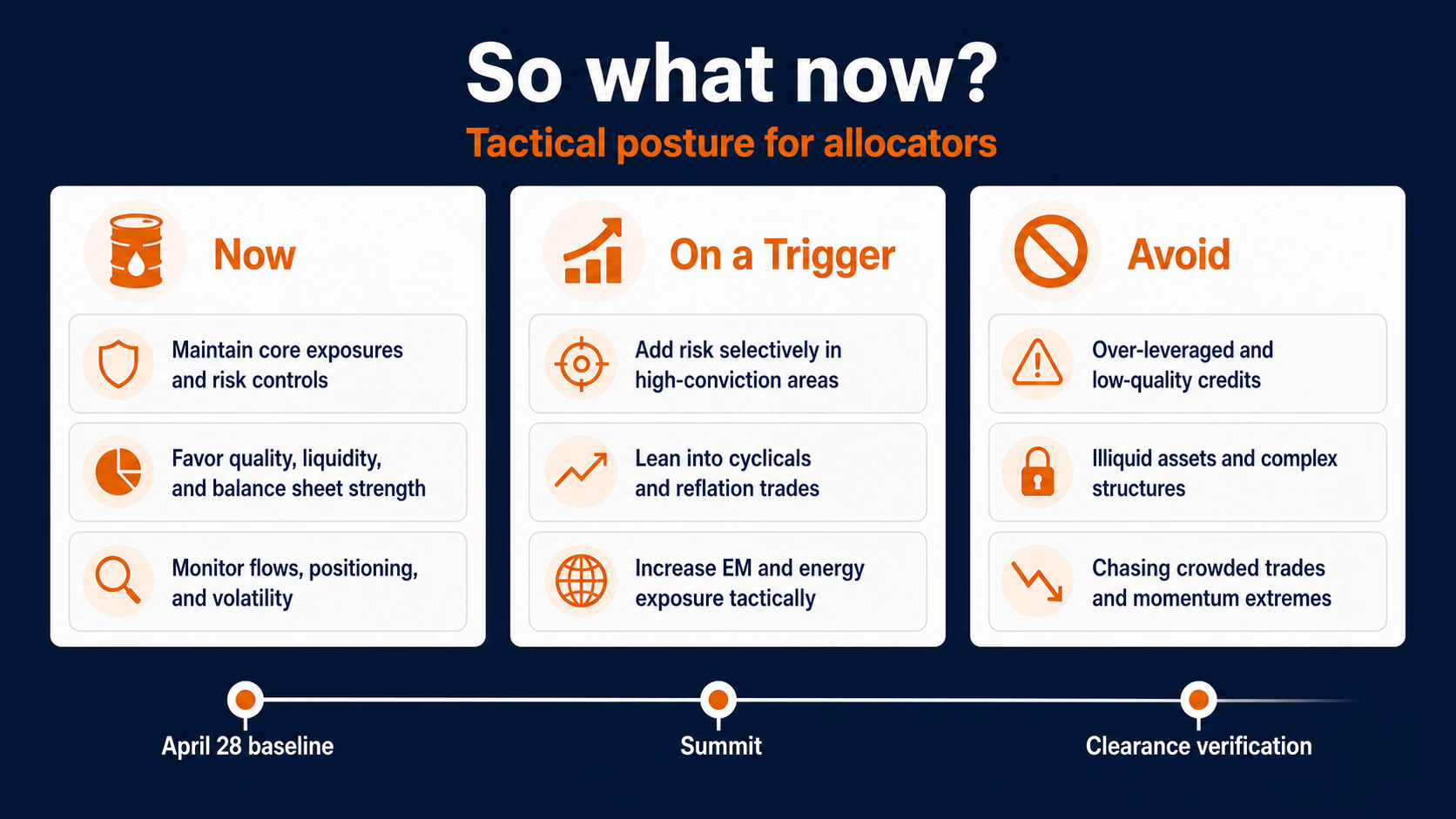
For capital allocators: position for near-term tightness and elevated volatility, while keeping a line of sight to medium-term relief following a successful clearance operation. The equity rip comes not when the Strait is “clear” but likely when third-party verification confirms the Strait is functionally reopening and Iran’s coercive capacity is materially degraded—even if the operation is still active and incomplete. Said otherwise, markets likely move on the inflection point towards durable freedom of navigation.
Before closing, it is worth being explicit about what could bend or invalidate this base case. The central thesis rests on the primacy of the physical clock (export capacity, storage, throughput) and on China’s incentive to remain pragmatic rather than sacrificial over Iran. There are, however, a set of lower-probability but non-trivial provocations that would widen the distribution of outcomes and warrant monitoring and hedging attention:
Asymmetric Iranian escalation outside the Gulf: credible attacks on regional infrastructure or third-country energy facilities; market impact: sharper risk-off in EM and regional equities, temporary spikes in insurance and freight premia.
Chinese domestic nationalist pressure: visible public backlash or elite messaging tying China’s prestige directly to Iran; market impact: shorter runway for transactional bargaining, higher odds of Beijing signaling firmer opposition, wider risk premia on trade-sensitive assets.
Russian opportunism: coordinated political or military moves by Moscow to shield Tehran or complicate Western logistics; market impact: tighter geopolitical correlation across commodities and FX, more complex sanctions enforcement.
Operational surprises at export nodes: secondary damage, sabotage, or accelerated well shut-ins at Kharg or similar hubs; market impact: steeper near-term oil spikes, faster downstream inventory drawdown, earlier profit triggers on hedged energy exposure.
Denial-network over-performance: proxy or maritime campaigns achieving higher-impact disruption than anticipated; market impact: prolonged dislocation in maritime insurance and sustained upside pressure on energy prices.
These are risk amplifiers, not alternative cores. They can change the path, but they do not on their own overturn the underlying mechanics compressing Tehran’s export options or the sequencing advantage Washington retains. They are precisely the scenarios to monitor and hedge against while still trading the central case.
The United States has managed this confrontation with deliberate tempo—sequencing pressure, diplomacy, and signaling to maximize flexibility while minimizing uncontrolled spillover. The China summit fits into that sequencing.
It is not a turning point. It is the final pause before physics takes over, one way or another.
Disclaimer: This note is provided for informational purposes only and does not constitute investment, financial, or legal advice. The information contained herein is based on current market observations and analysis, which are subject to change without notice. All investments involve risk, including the loss of principal. We do not provide personalized recommendations, and readers should conduct their own due diligence or consult with a qualified professional before making any investment decisions.