

The Three Paths: Why Escalation Is Now the Path of Least Resistance in Iran
Three paths forward on Iran, one timeline that matters, and why military clearing is the only viable option

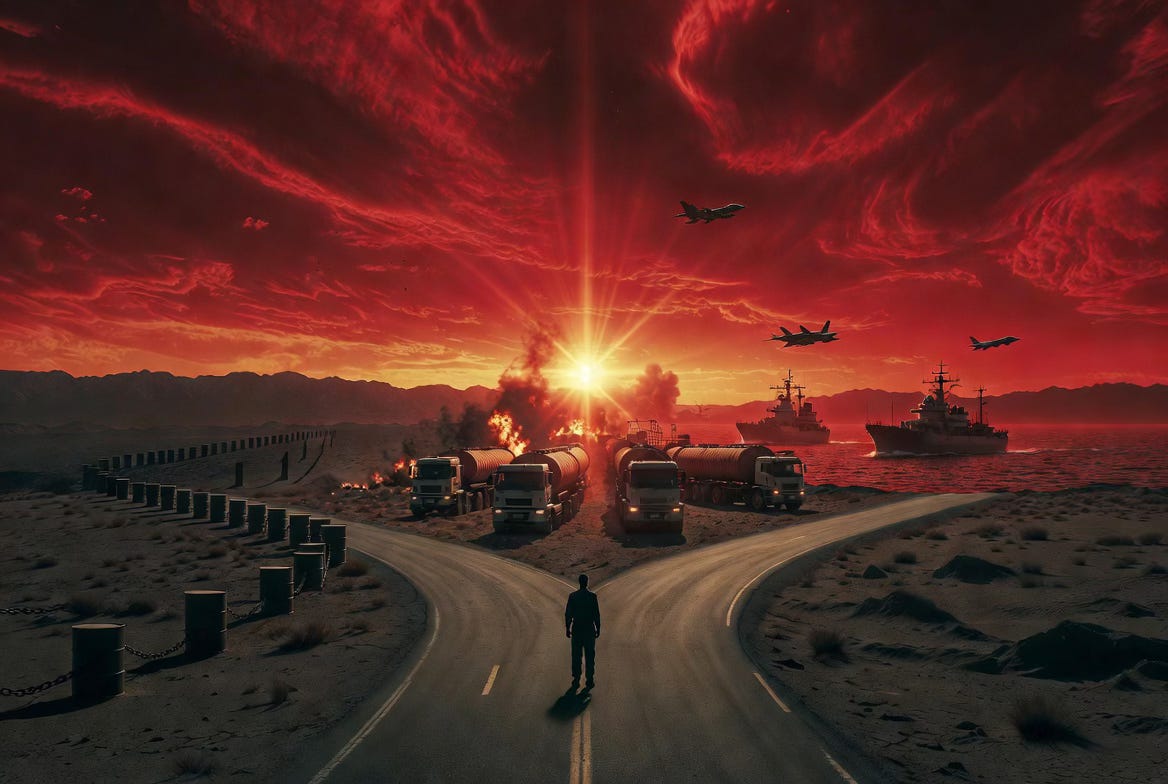
The last 48 hours have clarified what the last several weeks only hinted at: we are at a genuine fork in the road on Iran. From a decision making perspective it is fairly easy to assume that decision point is to sign a “deal” or escalate militarily. That is correct at 50,000 feet, but a deeper look into those options makes the decision more complex than go or no-go.
In that vein, there are three realistic paths forward. Only one of them actually solves the problem in a timeframe that matters.
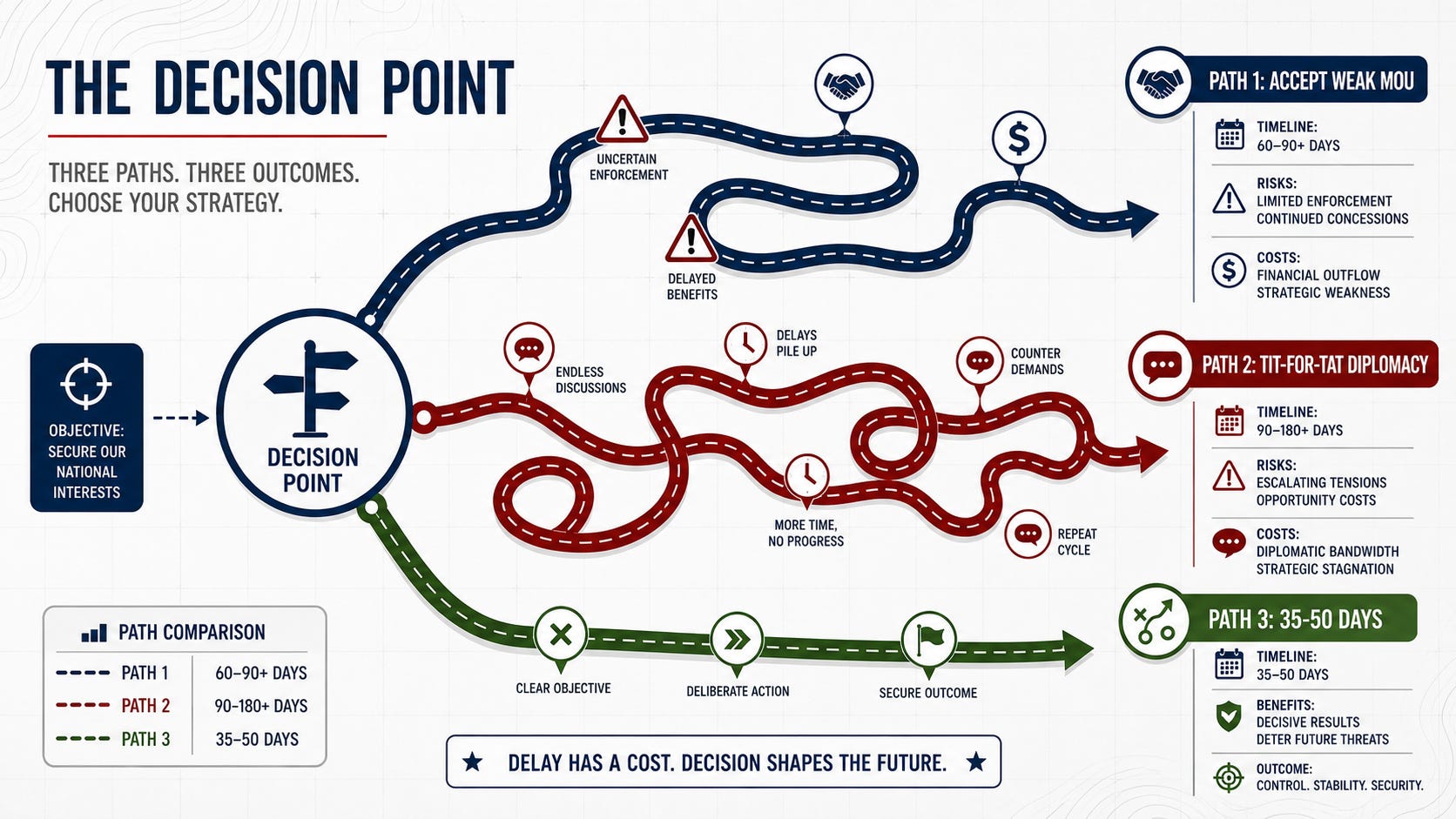
Path 1: Accept the weak MOU
This is the face-saving ceasefire extension currently on the table. Sanctions relief for Iran, a paper reopening of the Strait of Hormuz after a 30-day mine-clearing window, and the nuclear file deferred for another 30–60 days with soft language and no immediate, verifiable rollback of the HEU stockpile.
The MOU’s weaknesses are structural: no credible progress on the nuclear file, the Strait remains under Iranian institutional control, US military assets are removed during the nuclear talks, and material sanctions relief is delivered upfront just to keep the conversation going. These are not minor concessions. They are the core issues that triggered the conflict.
From the US perspective, this is a strategic retreat on both red lines discussed since the beginning of the conflict. Iran keeps institutional leverage over the Strait, economic breathing room, and a domestic victory narrative on restored internet. The US gets a pause and some optics.
Timeline to functional normalization? 60–90+ days. Thirty days to clear mines, and likely another 30 or more to start operating more normally. Logistics, insurance markets, trust, and rerouting do not flip like a light switch. With serious energy problems now forming and on the horizon, this path gives a reasonably clear timeline for expecting normalized or improved traffic through the Strait of Hormuz. The cost of that is an empowered Iran with a strengthened IRGC and no US objectives met.
For the US, this would be a loss at home, a loss with allies, and a strategic failure on the nuclear file. It sets dangerous precedents for other chokepoints and weakens deterrence across the board. The IRGC comes out stronger, not weaker. That is not a win — it is a deferral of the problem at best and a surrender at worst.
On the other hand, it would be positive for global energy in the short term as crude flows would have a more definable light at the end of the tunnel to normalcy for the global economy. However, the durability of that freedom of navigation may remain in question, and continued hesitancy around Gulf shipping should be expected as long as Iran controls or effectively controls the Strait of Hormuz.
Path 2: Tit-for-tat then back to talks
This path combines maximum timeline elongation with zero strategic gain. Absorb Iran’s retaliation for recent US strikes, pause, and try to restart diplomacy. It hands Iran initiative and narrative control while they drag things out, a defined Iranian negotiating tactic. The real resolution gets pushed deep into the 60–90+ day window where Europe is already at operational minimums and the US follows shortly after.
This maximizes economic pain with minimal strategic gain. It guarantees the longest period of disruption. When factoring in time to reset diplomacy, clear the Strait, and see shipping normalize, that likely takes matters well into July if not August. Global energy markets and the broader economy cannot tolerate a strait that remains in its current disposition for that period of time. This is the path most likely to trigger a global recession.
Path 3: Focused military clearing operation
Practically, this is the only path that solves the problem quickly and decisively. Targeted degradation of the denial network, Kharg Island storage and export capacity, mobility and logistics nodes, and nuclear support infrastructure strikes. Or, a more likely scope for this engagement, militarily force reliable freedom of navigation under sustained US and allied presence.
Realistic timeline: 2–4 weeks of high-intensity operations leading to a functional Strait of Hormuz by early-to-mid July. This is time-bounded pain. It is the faster resolution of the mechanical supply problem that actually matters right now.
That view is not without higher short-term risk and market volatility. This could increase the probability of Gulf infrastructure being targeted and further dampening supply. But it prevents the long, grinding economic bleed of Path 1 and especially Path 2. It also restores credibility and deters future adventurism at other chokepoints around the world. To the extent there is additional pain or disruption, it is likely condensed.
The data has been consistent for weeks: Iran has not folded on the two crown jewels. The Pakistan-mediated MOU was always a weak compromise that includes several non-starters for both sides. The administration explored it as a usable off-ramp, but the signals — Bandar Abbas strike, persistent tanker orbits, Lebanon green light, dual war cabinet meetings — show they are keeping the kinetic track alive and, if anything, moving closer to it.
The economic clock is unforgiving. Europe is roughly 30 days from serious minimums. The US is roughly 45 days. Any path that elongates this into late Q3 or Q4 is structurally damaging economically both at home and abroad.
We are at the fork. Path 3 is the only one that actually solves the problem on a timeline that matters for the global economy, if it can be accomplished. The others are different flavors of deferral that lead to a slow bleed of broader economic conditions.
Diplomacy is always the preferred path, for a lot of reasons. Unfortunately, the longer the US clings to the notion of a “deal” while both parties remain far apart, the higher the cost over a longer timeline if the terms don’t accomplish stated objectives.
On this basis, the US meeting at Camp David is likely to center heavily around renewed US military engagement and mitigation of fallout. The probability of that increases depending on how strong Iran’s response to the most recent US strikes turns out to be. The odds favor a significant retaliatory strike, consistent with Iran’s escalation pattern following prior strikes on critical assets, against the backdrop of their internet being back online and the citizenry hearing IRGC commentary that Iran has won and Trump along with the US has been defeated. Infrastructure hits in the Gulf, renewed mine-laying, or attacks on forward US positions would all serve the IRGC’s domestic narrative needs. A weak response would do no favors for the IRGC internally.
What would change my view?
As always, several things could and may change — but all appear low probability at this stage:
Iran fully acquiesces on the nuclear file and surrenders HEU stockpiles to US or IAEA control.
Iran cedes institutional control over the Strait of Hormuz, including tolling and enforcement authority.
US strike operations fail catastrophically, forcing a return to Path 1 under worse terms.
Iranian leadership is eliminated or restructured such that new negotiators arrive willing to meet US terms.
The US secures a major offsetting win, such as major Abraham Accords expansion, that changes the strategic calculus.
Major military escalation elsewhere forces US attention and resources away from the Gulf.
Allied Gulf states openly threaten direct military engagement against Iran absent concessions.
China or Russia apply sufficient pressure on Iran to force meaningful concessions at the negotiating table.
NATO commits to direct combat involvement in Gulf operations, fundamentally changing force posture and timeline.
The reality is that anything short of actual Iranian capitulation on core issues produces either a prolonged grind or a weak outcome that defers the problem. Coalition-pressure scenarios might accelerate diplomacy, but they are unlikely to deliver US red-line objectives without the credible threat that Path 3 represents. Absent one of these scenarios materializing, the logic outlined above holds.
The path to escalation is now functionally embarked on.
Disclaimer: This note is provided for informational purposes only and does not constitute investment, financial, or legal advice. The information contained herein is based on current market observations and analysis, which are subject to change without notice. All investments involve risk, including the loss of principal. We do not provide personalized recommendations, and readers should conduct their own due diligence or consult with a qualified professional before making any investment decisions.